


TMOTOR AM670 3D Power System Kit for Fixed-Wing Aircraft: High-Performance Power for 67-Inch 3D Aerobatic Models
SEO Title: TMOTOR AM670 3D Power System Kit for Fixed-Wing Aircraft | 480KV & 520KV
Meta Description: Discover the TMOTOR AM670 3D Power System Kit for 67-inch high-performance fixed-wing aircraft. Compare 480KV and 520KV motors, thrust, power, ESC telemetry, propeller options, and specifications.
Primary Keyword: TMOTOR AM670 3D Power System Kit
Secondary Keywords: TMOTOR AM670, AM670 motor, 3D aircraft power system, fixed-wing power system, 480KV motor, 520KV motor, AM116A ESC, RC aircraft power system, 67-inch 3D aircraft motor
Introduction
For high-performance 3D aerobatic aircraft, the power system is one of the most important components influencing acceleration, vertical performance, hovering ability, control response, and overall flight character. A motor may have impressive peak power, but a successful 3D setup also needs the right balance of torque, weight, propeller matching, ESC performance, cooling, and controllability.
The TMOTOR AM670 3D Power System Kit is designed around these requirements. Developed for approximately 67-inch-class high-performance 3D aerobatic aircraft, the system combines the TMOTOR AM670 brushless motor, AM116A intelligent ESC, and compatible CARBON-series propeller options. The system is available in 480KV and 520KV configurations, allowing pilots to select between efficiency-oriented performance and higher peak thrust.
With a maximum tested thrust of approximately 9.35 kg for the AM670 480KV with an 18×10 propeller and approximately 10.13 kg for the AM670 520KV with an 18×10 propeller, the AM670 is aimed at pilots who need strong power reserves for aggressive aerobatics, vertical maneuvers, hovering, rapid acceleration, and precision 3D flight.
What Is the TMOTOR AM670 3D Power System Kit?
The TMOTOR AM670 is more than an individual electric motor. It is a matched power-system solution intended to simplify the selection of the major propulsion components for a high-performance fixed-wing model.
The core system consists of:
-
TMOTOR AM670 brushless motor
-
TMOTOR AM116A intelligent ESC
-
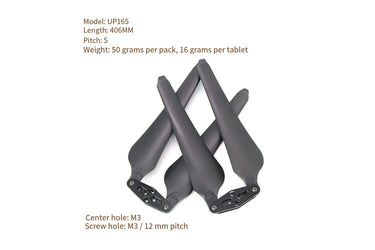
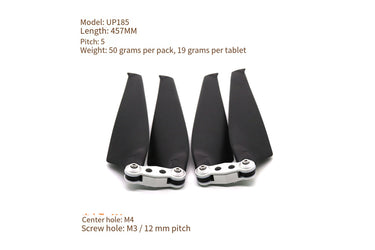
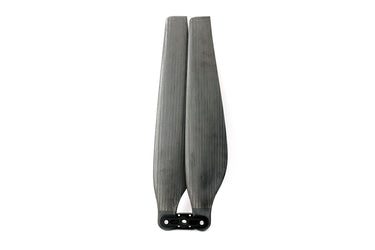
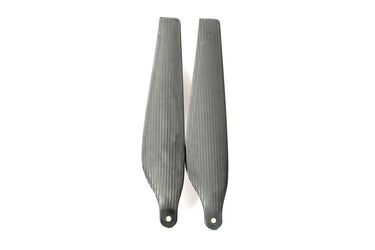
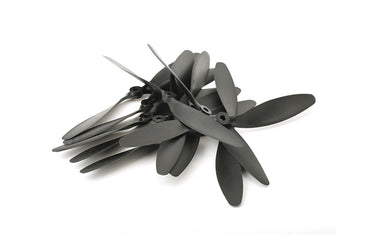
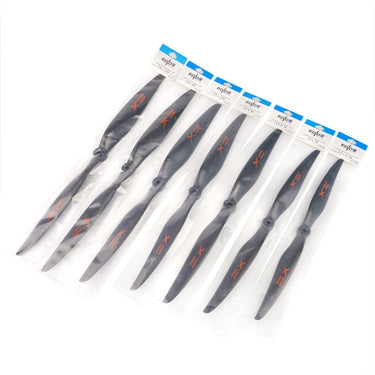
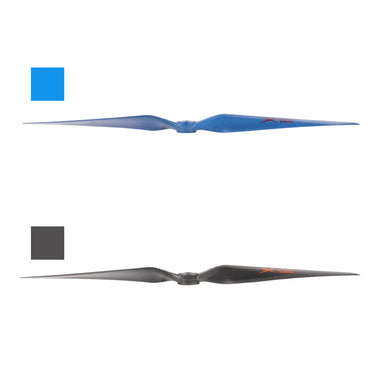
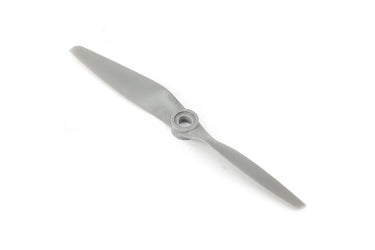
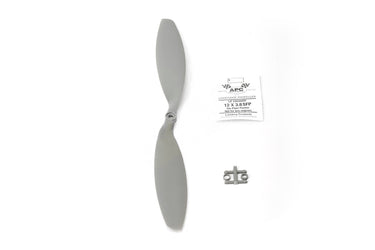
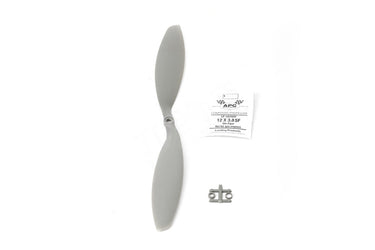
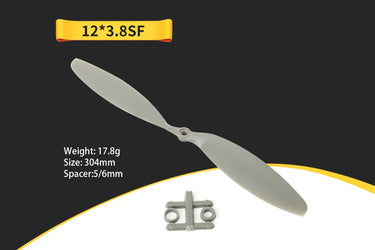
CARBON-series propeller
-
Related mounting and installation components depending on the selected configuration
The UAVMODEL product page lists several configurations, including:
-
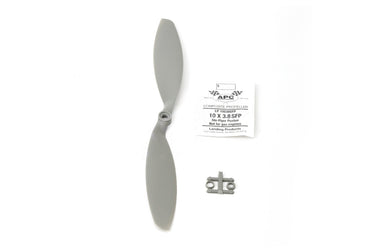
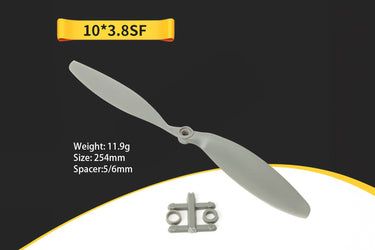
AM670 480KV + AM116A + FS18×8 propeller
-
AM670 520KV + AM116A + FS18×8 propeller
-
AM670 480KV + FS18×8 propeller
-
AM670 520KV + FS18×8 propeller
The system is specifically positioned for 67-inch-class 3D aerobatic aircraft, with the manufacturer's matching information also covering approximately 67–70-inch and 90E–110E aircraft categories.
This integrated approach is valuable because propulsion performance depends on the interaction between the motor, ESC, propeller, battery voltage, and aircraft weight. Instead of selecting every component independently, pilots can start from a power system that has already been matched around a 6S operating platform.
Key Advantages of the TMOTOR AM670
1. High Torque for 3D Aerobatic Flight
3D aerobatic aircraft place very different demands on a power system compared with conventional sport aircraft.
During a normal cruise, the motor may operate at moderate throttle for extended periods. During a 3D maneuver, however, the aircraft may suddenly require a large increase in thrust. Hovering, torque rolls, waterfalls, harriers, elevators, and rapid vertical transitions all benefit from strong low-speed torque and fast throttle response.
The AM670 uses a relatively large-diameter motor design to provide strong torque and dynamic response. Its 24N20P configuration and 8 mm shaft are designed for a high-performance fixed-wing propulsion application.
For pilots, the practical benefit is not simply a high number on a specification sheet. Strong torque allows the propeller to maintain useful authority during rapid changes in throttle and aircraft attitude.
2. Lightweight Structural Design
Weight is particularly important on a 3D aerobatic aircraft.
A heavy propulsion system can increase wing loading, reduce agility, and require additional power simply to maintain the aircraft in the air. The AM670's design therefore emphasizes a high strength-to-weight ratio.
The product information states that its structural design increases overall strength by approximately 15% while reducing weight by 44 g compared with the referenced previous design. The open structure and integrated mounting base are also intended to simplify installation and improve weight distribution.
The AM670 motor itself weighs approximately:
-
416.1 g for the 480KV version
-
416.3 g for the 520KV version
Both versions share the same basic motor dimensions of approximately 63.5 × 103.6 mm.
For aerobatic aircraft, keeping propulsion weight under control can make a noticeable difference in control response.
AM670 480KV vs. AM670 520KV
One of the most important decisions when purchasing the AM670 system is choosing between the 480KV and 520KV versions.
The two motors have similar physical dimensions and weight, but their electrical characteristics and performance targets differ.
| Specification | AM670 480KV | AM670 520KV |
|---|---|---|
| Motor Weight | 416.1 g | 416.3 g |
| Dimensions | Φ63.5 × 103.6 mm | Φ63.5 × 103.6 mm |
| Internal Resistance | 12 mΩ | 10 mΩ |
| Configuration | 24N20P | 24N20P |
| Shaft Diameter | 8 mm / 8 mm | 8 mm / 8 mm |
| Recommended Battery | 6S LiPo | 6S LiPo |
| No-Load Current at 10V | 3.5 A | 4.2 A |
| Maximum Current, 180 s | 110 A | 130 A |
| Maximum Power, 180 s | 2700 W | 3200 W |
| Recommended ESC | AM116A | AM116A |
| Recommended Propeller | 18×10 | 18×8 |
The manufacturer recommends the 480KV version for pilots who prioritize smoother control, efficiency, and endurance, especially when the aircraft is toward the lower or middle part of the recommended weight range. The 520KV version is intended for pilots seeking stronger peak thrust, faster acceleration, and more aggressive vertical performance.
When Should You Choose 480KV?
The AM670 480KV is an excellent choice when your aircraft is relatively light and you want a balanced combination of power and efficiency.
It is particularly suitable for:
-
Sport aerobatics
-
3D flying with moderate aircraft weight
-
Long practice sessions
-
Smooth throttle control
-
Efficient vertical flight
-
Pilots who do not need maximum possible thrust
The published matching data lists a suitable 3D/sport aircraft weight of approximately 4.2–5.0 kg for the 480KV version.
When Should You Choose 520KV?
The AM670 520KV is the more aggressive option.
It is designed for pilots who want:
-
Maximum thrust
-
Faster throttle response
-
Strong vertical acceleration
-
More powerful hovering performance
-
Heavier 3D aircraft
-
More demanding aerobatic maneuvers
The recommended 3D/sport aircraft weight range is approximately 4.8–5.2 kg. The 520KV motor also has a higher published 180-second maximum current and maximum power rating.
For a heavier aircraft where vertical performance is a priority, the 520KV configuration can provide a useful additional power margin.
Propeller Matching for the AM670
Propeller selection has a major influence on the behavior of an electric aircraft.
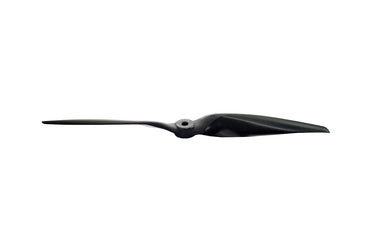
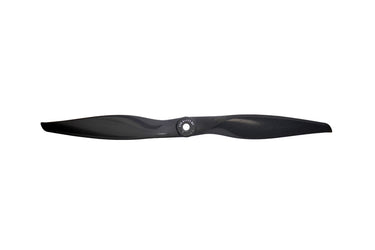
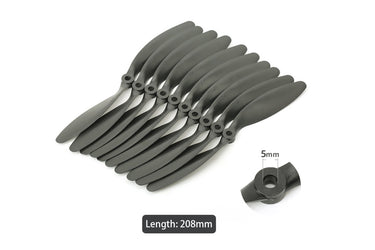
The AM670 system supports several propeller configurations, including:
-
17×8 for lighter-load flight
-
18×8 for efficient flight
-
18×10 for extreme flight
The recommended combination depends on the motor KV rating and the desired flight characteristics.
AM670 480KV with 18×8 Propeller
Manufacturer test data shows the AM670 480KV reaching approximately:
-
2,830 g thrust at 50% throttle
-
5,161 g thrust at 70% throttle
-
7,921 g thrust at 90% throttle
-
8,733 g thrust at 100% throttle
At full throttle with the 18×8 propeller, the test result was approximately 2,040 W, 8,263 RPM, and 8.73 kg of thrust.
This combination provides a good balance between power and efficiency and is useful for pilots who want strong thrust without moving immediately to the higher load of an 18×10 propeller.
AM670 480KV with 18×10 Propeller
The 18×10 propeller increases the load on the motor and delivers higher thrust.
According to the published test data, the 480KV motor produced approximately:
-
3,147 g thrust at 50% throttle
-
5,707 g thrust at 70% throttle
-
8,464 g thrust at 90% throttle
-
9,349 g thrust at 100% throttle
At full throttle, the test reached approximately 2,380 W, 7,858 RPM, and 9.35 kg of thrust.
This configuration is particularly attractive for aggressive 3D flight where maximum thrust is more important than peak electrical efficiency.
AM670 520KV Performance
The 520KV version is the higher-output configuration.
With an 18×8 propeller, published testing recorded:
-
3,212 g thrust at 50% throttle
-
5,823 g thrust at 70% throttle
-
8,822 g thrust at 90% throttle
-
9,617 g thrust at 100% throttle
At full throttle, the system reached approximately 2,395 W, 8,636 RPM, and 9.62 kg of thrust.
The higher-KV motor can therefore produce substantial thrust without requiring the larger 18×10 propeller.
AM670 520KV with 18×10 Propeller
For maximum tested thrust, the 520KV motor paired with the 18×10 propeller is the most powerful combination listed in the test data.
At full throttle, it reached approximately:
-
131.23 A
-
2,773.70 W
-
8,138 RPM
-
2.503 N·m torque
-
10,132 g thrust
-
3.65 g/W efficiency
This is the configuration responsible for the manufacturer's stated 10.1 kg-plus peak thrust figure.
Such a setup is intended for pilots who need maximum vertical authority and rapid acceleration rather than maximum endurance.
Intelligent AM116A ESC
A high-performance motor needs an ESC capable of handling its electrical demands. The AM670 system is matched with the AM116A intelligent ESC.
One of the most useful features is its telemetry capability.
Depending on the compatible radio and aircraft electronics setup, flight information can include:
-
BEC voltage
-
ESC temperature
-
Motor RPM
-
Real-time current
-
Power voltage
-
Cumulative power consumption
This information allows pilots to monitor the propulsion system during flight instead of relying solely on post-flight inspection.
Why ESC Telemetry Matters
Telemetry is particularly useful on high-performance electric aircraft because current consumption can change significantly according to throttle position, propeller selection, aircraft attitude, and flight style.
For example, a pilot can monitor cumulative power consumption to better estimate remaining battery capacity. ESC temperature information can also provide an early indication of excessive thermal load.
RPM feedback can help identify whether the propulsion system is behaving consistently. Abnormal RPM changes may indicate a problem with the motor, propeller, battery, ESC, or electrical connections.
For pilots who frequently operate close to the upper performance limits of their aircraft, this additional information can make power-system management more predictable.
Adjustable Propeller Hub Design
Installation precision is another important consideration for high-performance fixed-wing aircraft.
The AM670 uses an adjustable propeller hub design with approximately ±3 mm of adjustment. This allows the propeller position to be fine-tuned during installation.
This feature can help with three important areas.
Better Motor Alignment
The adjustment range can make it easier to align the motor shaft correctly with the aircraft's centerline.
Better Spinner and Cowl Clearance
The propeller position can be adjusted to achieve an appropriate gap between the propeller, spinner, and fuselage or cowl.
Easier Installation
Instead of requiring extremely precise fuselage machining from the beginning, the adjustment mechanism provides some installation flexibility.
For scale and aerobatic aircraft where the spinner-to-cowl gap is visually important, this is also useful for achieving a clean finished appearance.
HARD LOCK Propeller Nut and Cooling Design
3D aerobatic aircraft can place significant mechanical and thermal stress on the propulsion system.
The AM670 incorporates a HARD LOCK nut and optimized cooling structure to support demanding high-load operation. The goal is to maintain stable propulsion performance during repeated high-power maneuvers.
Cooling is particularly important because electrical power eventually becomes a combination of mechanical output and heat. When a motor is repeatedly operated at high current, thermal management becomes increasingly important.
The AM670's open structural design also supports airflow around the motor, which can be advantageous during high-load operation.
Recommended Aircraft Size and Weight
According to the manufacturer's matching table, both AM670 KV versions are intended for approximately 67–70-inch / 90E–110E 3D or sport aircraft.
The recommended aircraft weight ranges are:
AM670 480KV
-
3D/sport aircraft: approximately 4.2–5.0 kg
-
Scale/drone applications: approximately 25–28 kg, according to the manufacturer's matching table
AM670 520KV
-
3D/sport aircraft: approximately 4.8–5.2 kg
-
Scale/drone applications: approximately 28–31 kg, according to the manufacturer's matching table
The scale/drone figures should be evaluated according to the specific aircraft configuration and operating requirements rather than treated as universal recommendations.
For conventional 3D fixed-wing applications, the 4.2–5.2 kg ranges are the more relevant figures.
Why a Matched Power System Is Better Than Random Component Selection
Building a high-power electric aircraft from individual components can be complicated.
The motor must be compatible with the battery voltage. The ESC must handle the expected current. The propeller must match the motor's KV rating and power capability. The aircraft must also remain within a sensible weight range.
A mismatch can create several problems.
An oversized propeller may push current beyond the safe operating range of the motor or ESC. An undersized propeller may reduce thrust and make the aircraft feel underpowered. A battery with insufficient current capability can cause voltage sag and poor throttle response.
The AM670 kit reduces some of this uncertainty by offering matched motor, ESC, and propeller configurations.
This is especially useful for pilots building a new aircraft and looking for a known starting point.
TMOTOR AM670 for 3D Aerobatic Flying
The AM670 is particularly well suited to flight styles that require rapid changes in thrust.
Hovering
A high thrust-to-weight ratio is essential for sustained hovering. The AM670's high peak thrust provides considerable power reserve for aircraft in its recommended weight range.
Torque Rolls
Torque rolls require precise throttle management and enough propeller authority to maintain the aircraft's position. The large-diameter motor and compatible large propellers provide the torque needed for this type of maneuver.
Harriers
Harrier flight requires stable, controllable power at relatively high angles of attack. A responsive propulsion system can make throttle adjustments easier during low-speed aerobatic flight.
Vertical Climb
The AM670 520KV configuration is particularly attractive when vertical acceleration is a major priority. With more than 10 kg of published peak thrust in the 18×10 test configuration, it provides substantial thrust reserve for appropriately matched aircraft.
Precision Aerobatics
For pilots who value predictable throttle response and smooth power delivery, the 480KV version can be an appealing alternative to the more aggressive 520KV configuration.
AM670 480KV vs. 520KV: Which One Is Better?
There is no universally better version. The correct choice depends on the aircraft and the pilot's priorities.
| Flight Priority | Recommended Version |
|---|---|
| Efficiency | AM670 480KV |
| Smooth control | AM670 480KV |
| Longer practice sessions | AM670 480KV |
| Lighter aircraft | AM670 480KV |
| Maximum thrust | AM670 520KV |
| Aggressive vertical flight | AM670 520KV |
| Faster acceleration | AM670 520KV |
| Heavier aircraft | AM670 520KV |
If your aircraft is close to the lower end of the recommended weight range, the 480KV configuration is a sensible starting point.
If your aircraft is heavier and your primary goal is maximum 3D performance, the 520KV configuration offers more power potential.
Battery and Electrical System Considerations
Both AM670 versions are specified around a 6S LiPo battery system.
Because the system can operate at very high current levels, the battery and electrical connections should be selected according to the actual motor, propeller, throttle, and flight requirements.
The 520KV motor has a published maximum current of 130 A for 180 seconds, while the 480KV version is rated at 110 A for 180 seconds.
This means pilots should not select a battery solely based on nominal capacity. The battery must also be capable of delivering the required current while maintaining appropriate voltage under load.
High-current applications also make connector quality, wire sizing, solder joints, ESC installation, and airflow increasingly important.
Installation Recommendations
Before installing the TMOTOR AM670 power system, verify that the aircraft is structurally capable of handling the motor's thrust and torque.
Important installation considerations include:
1. Check Motor Mount Strength
The motor mount must be sufficiently rigid for high-power operation. Any flex in the motor mount can negatively affect propeller alignment and overall flight performance.
2. Verify Propeller Clearance
Always confirm adequate clearance between the propeller, fuselage, landing gear, cowl, and other components.
3. Check Shaft Alignment
Use the AM670's adjustment capability to achieve appropriate alignment with the aircraft centerline.
4. Confirm Propeller Balance
A large-diameter propeller operating at thousands of RPM should be properly balanced before flight.
5. Provide Adequate Cooling
High-power electric propulsion generates significant heat. Ensure that the ESC and motor receive sufficient airflow.
6. Secure All Electrical Connections
High-current connections should be mechanically secure and properly insulated.
7. Perform a Ground Test
Before the first flight, gradually increase throttle and monitor current, voltage, RPM, ESC temperature, and motor behavior.
Understanding the Published Test Data
Performance numbers for electric aircraft propulsion should always be interpreted in context.
The published AM670 data is based on specific combinations of:
-
Motor KV
-
Propeller size
-
Battery voltage
-
Throttle position
-
Electrical load
-
Test conditions
For example, the AM670 480KV with an 18×10 propeller produced approximately 9.35 kg of thrust at 100% throttle, while the AM670 520KV with the same propeller produced approximately 10.13 kg.
These figures demonstrate the potential of the power system, but actual aircraft performance will vary depending on airframe weight, propeller model, battery condition, ESC settings, installation, altitude, temperature, and other factors.
Therefore, published bench-test numbers should be used as a reference rather than a guarantee of exact in-flight thrust.
Efficiency vs. Maximum Power
One important characteristic of the AM670 system is the trade-off between thrust and electrical efficiency.
As throttle increases, thrust increases substantially, but the measured grams-per-watt efficiency generally decreases.
For example, the AM670 480KV with the 18×8 propeller produced approximately 7.38 g/W at 40% throttle and 4.28 g/W at 100% throttle in the published test.
This illustrates an important principle for 3D aircraft:
Maximum power should be used when maximum power is actually required.
During normal cruising or gentle aerobatics, moderate throttle can reduce energy consumption and extend flight time. Full throttle is most valuable during takeoff, vertical climbs, hovering, aggressive maneuvers, and other situations where maximum thrust is needed.
Who Should Buy the TMOTOR AM670?
The AM670 3D Power System Kit is a strong candidate for:
-
67-inch-class 3D aerobatic aircraft
-
High-performance RC fixed-wing aircraft
-
Sport aerobatic models
-
90E–110E-class aircraft
-
Pilots building lightweight but powerful electric aircraft
-
Pilots who need strong vertical performance
-
Advanced RC pilots who want telemetry-enabled propulsion
-
Builders who prefer a matched motor, ESC, and propeller solution
It is less appropriate for small trainers, lightweight park flyers, or aircraft that do not require high-power propulsion.
Frequently Asked Questions
Is the TMOTOR AM670 suitable for 3D aerobatic aircraft?
Yes. The system is specifically designed for high-performance 3D aerobatic aircraft, particularly models around the 67-inch class.
What battery does the AM670 use?
Both the 480KV and 520KV versions are specified for a 6S LiPo battery.
What is the maximum thrust of the AM670?
In the published test data, the AM670 480KV produced approximately 9.35 kg of thrust with an 18×10 propeller, while the 520KV version produced approximately 10.13 kg with an 18×10 propeller.
Which is better, AM670 480KV or 520KV?
The 480KV version is better suited to efficiency, smoother control, and lighter aircraft. The 520KV version is intended for higher peak thrust, faster acceleration, and heavier or more aggressive 3D aircraft.
What ESC should I use with the AM670?
The recommended ESC is the TMOTOR AM116A intelligent ESC for both the 480KV and 520KV versions.
What propellers are recommended?
The published matching table lists 17×8, 18×8, and 18×10 configurations, with the preferred option depending on the motor KV and desired flight characteristics.
Does the AM116A ESC support telemetry?
Yes. The intelligent ESC is designed to provide real-time information such as BEC voltage, ESC temperature, motor RPM, current, power voltage, and cumulative power consumption.
How much does the AM670 motor weigh?
The 480KV motor weighs approximately 416.1 g, while the 520KV version weighs approximately 416.3 g.
What aircraft size is recommended?
The manufacturer's matching information recommends approximately 67–70-inch / 90E–110E 3D and sport aircraft.
Final Verdict
The TMOTOR AM670 3D Power System Kit is designed for pilots who expect significantly more from an electric fixed-wing propulsion system than basic cruising performance.
Its combination of a large-diameter AM670 motor, intelligent AM116A ESC, compatible carbon propeller options, adjustable propeller positioning, high-current capability, and real-time telemetry makes it a comprehensive solution for demanding 3D aerobatic aircraft.
The choice between the two main motor versions is straightforward:
Choose the AM670 480KV if you want a balanced combination of efficiency, smooth throttle response, and strong aerobatic performance.
Choose the AM670 520KV if maximum thrust, aggressive vertical performance, and rapid acceleration are your primary objectives.
For a properly matched 67-inch-class 3D aircraft, the AM670 provides a substantial power reserve while maintaining the lightweight characteristics that are important for aerobatic flying. With published peak thrust exceeding 10 kg in the highest-output configuration, it is a propulsion system aimed squarely at serious RC pilots who want strong and controllable electric power.
For builders looking for a high-performance 6S fixed-wing motor system, 3D aerobatic aircraft power system, or complete TMOTOR propulsion solution, the AM670 deserves serious consideration.