

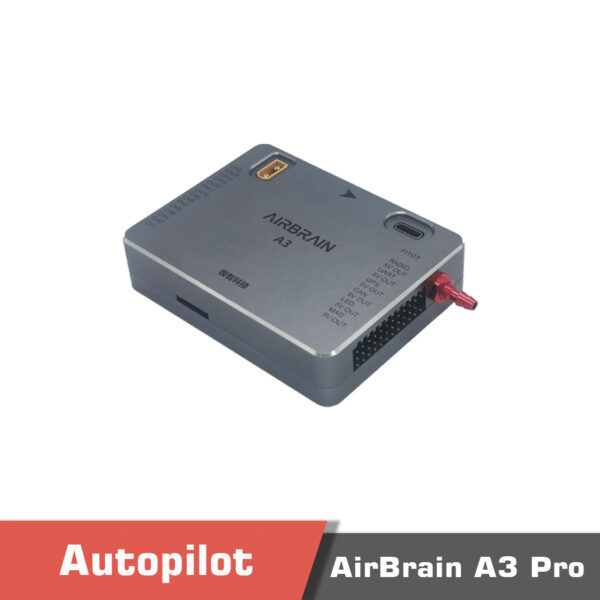
AirBrain A3PRO — Dedicated Flight Control System for Aerial Survey & AOPA Training
Professional flight controller for aerial survey, photogrammetry, and pilot training — industrial grade, multi-sensor redundancy, cross-wrap flight support, and simulator mode.
Introduction
In today’s rapidly evolving unmanned aerial vehicle (UAV) industry, professionals engaged in aerial surveying, mapping, and training operations demand flight control systems that deliver high precision, reliability, and intelligent usability. The AirBrain A3PRO is specifically designed to meet these needs. With an industrial-grade architecture, multi-sensor redundant design, and dedicated support for aerial survey and training missions, it offers a powerful solution for fixed-wing and VTOL UAV platforms.
This article examines the AirBrain A3PRO’s features, technical specifications, application scenarios, and advantages, written with SEO best practices in mind so teams and businesses can find and evaluate this flight controller quickly.
Why Choose the AirBrain A3PRO?
Target Audience & Use-Case Relevance
- Aerial Survey & Mapping: Tailored for orthophoto, 3D modelling, and corridor mapping with support for cross-wrap flight and precise path control.
- Pilot Training & AOPA-style Certification: Built-in simulator functionality for ground-station training and risk-free practice sessions.
- Industrial & Professional Operations: Designed for professional workflows with industrial-grade components and wide operating temperature range.
Key Differentiators (SEO-Friendly Focus)
- Triple IMU & Dual GPS: Enhanced redundancy and flight stability for mission-critical operations.
- Cross-wrap Flight Support: Efficient survey flight patterns that reduce overlap and processing time.
- Three-Axis Pan-Tilt Control: Precise gimbal control for survey cameras and sensors.
- Adaptive Vector Field Control Algorithm: Improved attitude stability and route accuracy, especially in windy conditions.
- Compact & Lightweight: Easy integration into UAVs with minimal weight and volume impact.
Technical Specifications
| Specification | Details |
|---|---|
| IMU sensors | 3 (triple IMU for redundancy) |
| GPS modules | 2 (dual GPS) |
| Component level | Industrial grade |
| Operating temperature | −20°C to +50°C |
| Suitable wingspan | 1–3 meters |
| Cross-wrap flight | Supported |
| Pan-tilt gimbal control | 3-axis pan-tilt supported |
| Size (L×W×H) | 82 × 62 × 19 mm |
| Weight | Approx. 90 g |
| Airspeed measurement | Dynamic pressure |
| Max power supply | Up to 12S (≈54 V) |
| Simulator | Built-in simulation flight via ground station |
Functional Features & Benefits
Flight Stability & Precision
The combination of triple IMUs and dual GPS provides improved fault tolerance and attitude stability—critical for mapping and surveying tasks where centimeter-level path accuracy matters. The adaptive vector field control algorithm further enhances stability in gusty conditions.
Survey Workflow Efficiency
Cross-wrap flight support enables efficient coverage with optimized overlap, often reducing the number of images required and lowering post-processing time and costs. This advantage is especially important for large orthomosaic and DSM workflows.
Training & Simulation
Built-in simulator functionality allows training institutions and certification centers to teach UAV piloting, mission planning, and gimbal control using a ground station without risking actual hardware, improving safety and shortening learning curves.
Integration & Flexibility
Compact size and light weight make the A3PRO easy to integrate into many fixed-wing and VTOL platforms. Support for 3-axis pan-tilt control and a wide input voltage range (to 12S) makes it compatible with diverse payloads and power systems.
Applications & Use-Case Scenarios
- Fixed-Wing Corridor Survey: Execute precise cross-wrap flight lines for pipelines, railways, and roads with stable flight paths and efficient imagery capture.
- VTOL Hybrid Inspection: Permit accurate transitions between vertical and forward flight with robust position holding for inspection tasks.
- Training Centers & Certification: Use the simulator mode to train students in mission planning and safe operation before live flights.
- Photogrammetry & 3D Modelling: Achieve high-quality orthomosaics and 3D reconstructions with fewer images and optimized flight planning.
Implementation Considerations
- Platform Integration: Confirm the airframe can accommodate the controller’s dimensions and that your power system supports up to 12S input.
- Payload Compatibility: Verify gimbal and camera interfaces to exploit 3-axis pan-tilt control.
- Environmental Limits: Operating temperature is −20°C to +50°C — for extreme environments consider thermal mitigation.
- Ground Station & Software: Ensure compatibility with your mission planning, telemetry, and payload control software.
- Training Workflow: Leverage simulator mode to reduce risk and shorten operator learning curves.
- Mission Planning: Use cross-wrap patterns and gimbal control to reduce image overlap and speed processing.
SEO-Optimised Keywords & Phrases
To improve discoverability on Google, include these keywords throughout the page, in headings, meta description, image alt-text, and product snippets:
- AirBrain A3PRO flight controller
- industrial-grade UAV flight control unit
- aerial survey mapping fixed-wing drone autopilot
- cross-wrap flight support for photogrammetry
- three-axis pan-tilt gimbal control UAV
- dual GPS triple IMU redundancy flight controller
- UAV pilot training simulator mode
- vector field control algorithm wind resistance UAV
- 1.5 cm resolution aerial mapping drone fixed wing
Summary & Recommendations
The AirBrain A3PRO is a purpose-built flight control system for professional aerial survey and training operations. Its multi-sensor redundancy, industrial components, simulator mode, and cross-wrap support make it a strong choice for survey companies, inspection teams, and training institutions. When choosing a flight controller for high-precision workflows, consider the A3PRO for improved stability, reduced imaging/post-processing costs, and safer pilot training.